
It's not your bones. It's not your discs. It's not your age. Scientists now know there's a hidden part of your spine that controls everything — and every treatment you've tried has completely ignored it.


You know the feeling by now.
You wake up stiff. You need twenty, thirty minutes just to move like a normal person.
You lean over the shopping cart — not because you're tired, but because it's the only way to take the pressure off your spine long enough to get through the store.
You've stopped making plans. You've stopped saying yes to things. Because you already know how it ends — standing for ten minutes, then that familiar crushing sensation in your lower back, then the burning down your leg, then the desperate search for somewhere to sit.
Maybe you've had L4-L5 fusion. Or laminectomy. The surgeon said it went perfectly.
And yet here you are.
Or maybe you're still waiting — cycling through injections that work for three weeks, physical therapy that hurts too much to finish, and doctors who keep telling you "you'll probably need surgery eventually."
Either way, you're doing everything right. And nothing is working.
Here's what nobody has told you yet:
It's not because your spine is unfixable. It's because every single treatment you've tried is targeting the wrong thing.

Sound Familiar?
✓ You feel instant relief the moment you lean forward — over a cart, a counter, or kneeling on the floor
✓ You wake up at 3AM and can't roll over without your back seizing
✓ You need a full thirty minutes to "warm up" before you can move normally
✓ Standing feels impossible after five minutes, but sitting is fine
✓ You've scanned every room you walk into for the nearest chair
✓ You've had surgery — or injections — and the pain came right back
If even one of those hit home, keep reading.
Because what you're experiencing has a specific cause. And it's one that almost no doctor ever checks for.
Why Everything Has Failed You

Let's be direct about what each treatment actually does — and why it keeps failing.
Pain pills and gabapentin reduce the pain signal to your brain. But the structural collapse causing that signal is still happening. You're silencing the alarm while the building burns down
.
Epidural injections reduce inflammation around the compressed nerve. First shot: six months of relief. Second shot: three months. Third shot: three weeks. Your body builds tolerance because the mechanical cause never stopped.
Physical therapy tries to strengthen your core. But here's the problem: you cannot strengthen a muscle your brain has already shut down. So instead you recruit surface muscles that weren't designed for the job — they fatigue, spasm, and cause secondary pain. The deep foundation? Still offline.
TENS units send electrical pulses to your surface nerves to confuse the pain signal. Five to eight millimeters deep. It tingles. It feels like something is happening. But the moment you turn it off, you're right back where you started. Nothing changed.
Surgery — laminectomy or fusion — fixes the structural problem. The bones, the discs, the nerve space. And that part works. The surgery is successful.
But here's what your surgeon never told you:
Surgery cannot fix what's causing your spine to collapse in the first place.
Do you see the pattern? Every treatment targets the symptom — the pain signal, the inflammation, the bone pressing on the nerve.
Not one of them addresses the structural cause.
The Hidden Reason Your Spine Has No Support

Your spine isn't just a stack of bones.
It's held up by a deep stabilizing muscle that wraps around each vertebra — closer to your spine than any other muscle in your body. When this muscle is working, it acts as your spine's internal brace. It absorbs about 60 percent of the compressive force on your lower back. It keeps your vertebrae aligned, your spinal canal open, and your nerves protected.
But when you develop chronic compression — stenosis, disc problems, inflammation — your nervous system does something devastating.
It shuts this muscle down. Completely.
It's a protective response. Your brain is trying to prevent further damage by immobilizing the area. But once it shuts down, it doesn't just turn back on.
Not with rest. Not with stretching. Not with physical therapy exercises that focus on surface muscles.
And definitely not with surgery. Surgery addresses bones and discs. It doesn't reactivate muscle function.
So you can have successful decompression. Perfect fusion hardware. And if this muscle is still shut down, your spine has zero internal support.
Everything collapses. The spinal canal narrows again. The nerves get compressed again. The pain returns — even though the surgery was technically perfect.
This is what rehabilitation specialists call Core Muscle Lockout.
And here's what makes it particularly cruel: it's completely invisible on an MRI. Your imaging shows tissue. But it cannot show whether that tissue is firing or completely shut down. There is no standard test for it. No routine follow-up checks for it. Most doctors don't even know to look.
So the question your surgeon never asked — is your deep stabilizing muscle still working? — was the most important question of all.
The Muscle Nobody Told You About
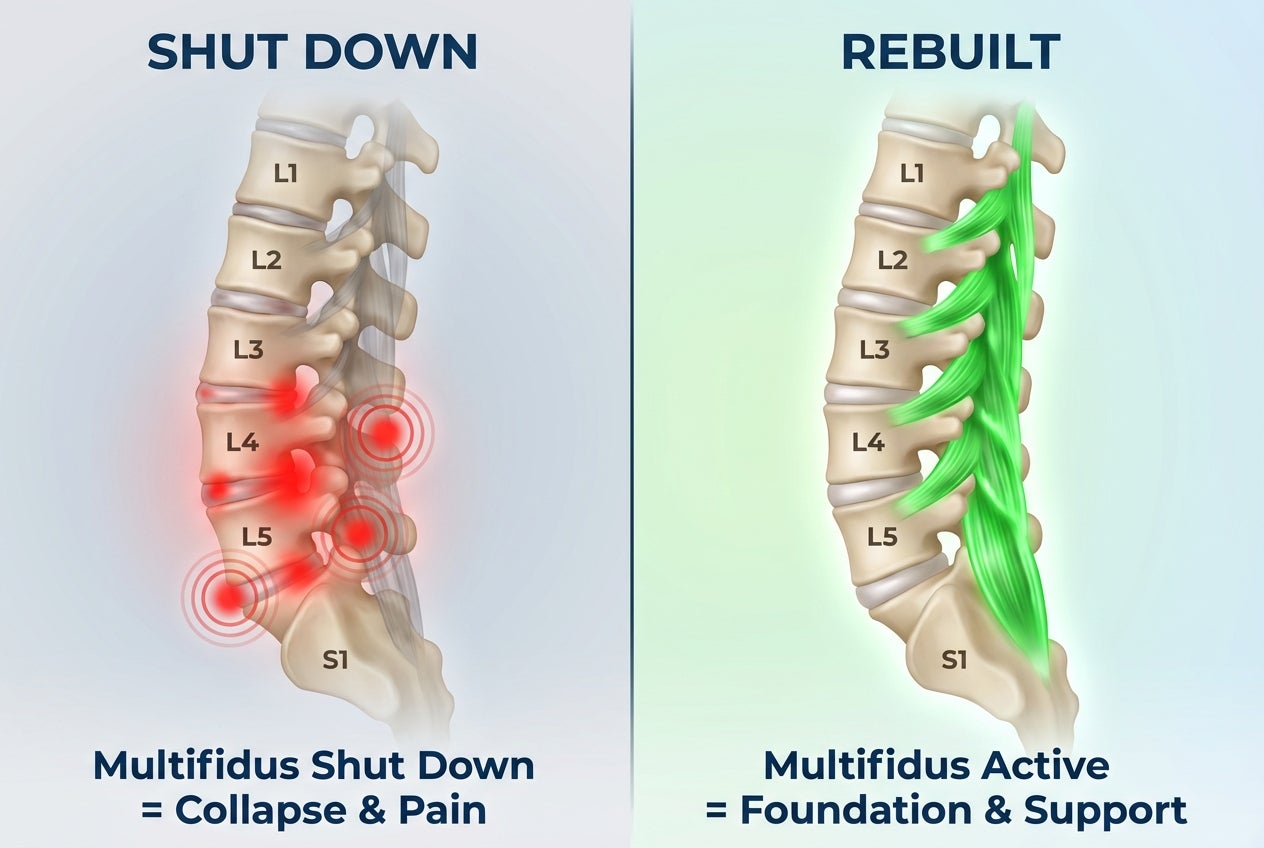
It's called the multifidus.
You've probably never heard of it. Most patients haven't. Many surgeons don't discuss it.
But it is the single most important stabilizer in your lumbar spine. It runs along both sides of your vertebrae at L4-L5 — the exact level where most stenosis, most fusions, and most failed surgeries happen.
When the multifidus is working, your spine has an internal brace. Load distributes evenly. Your canal stays open. Your nerves stay protected.
When the multifidus shuts down — Core Muscle Lockout — your entire body weight collapses directly onto your discs and nerves.
Now everything makes sense:
Why injections only last weeks: They reduce inflammation temporarily. But the mechanical pressure from the collapsed foundation continues the moment the medication wears off.
Why physical therapy didn't hold: You can't voluntarily contract a muscle your nervous system has blocked. The brain severed the connection.
Why TENS units feel like a joke: They reach five to eight millimeters deep. The multifidus sits thirty to fifty millimeters below the surface. They never even came close.
Why surgery often fails long-term: Fusion locks vertebrae together but doesn't restore the multifidus. So the levels above and below start compensating — and breaking down. Surgeons call this Adjacent Segment Disease.
Nobody tested your multifidus. Nobody checked if your foundation was still working.
But what if you could force it to wake up — without surgery, without needles, without another clinic visit?
The Breakthrough: Forcing The Foundation To Rebuild
For years, rehabilitation specialists knew about Core Muscle Lockout. And they tried to address it using a technology called NMES — Neuromuscular Electrical Stimulation.
The theory was sound: send electrical impulses deep enough to force the multifidus to contract — even when the brain has shut it down. Bypass the neurological block entirely.
But the technology wasn't powerful enough. Most consumer NMES devices — and definitely TENS units — use weak, single-frequency pulses that only reach surface tissue. They couldn't penetrate the thirty to fifty millimeters needed to reach the stabilizing muscle that actually matters.
Until now.
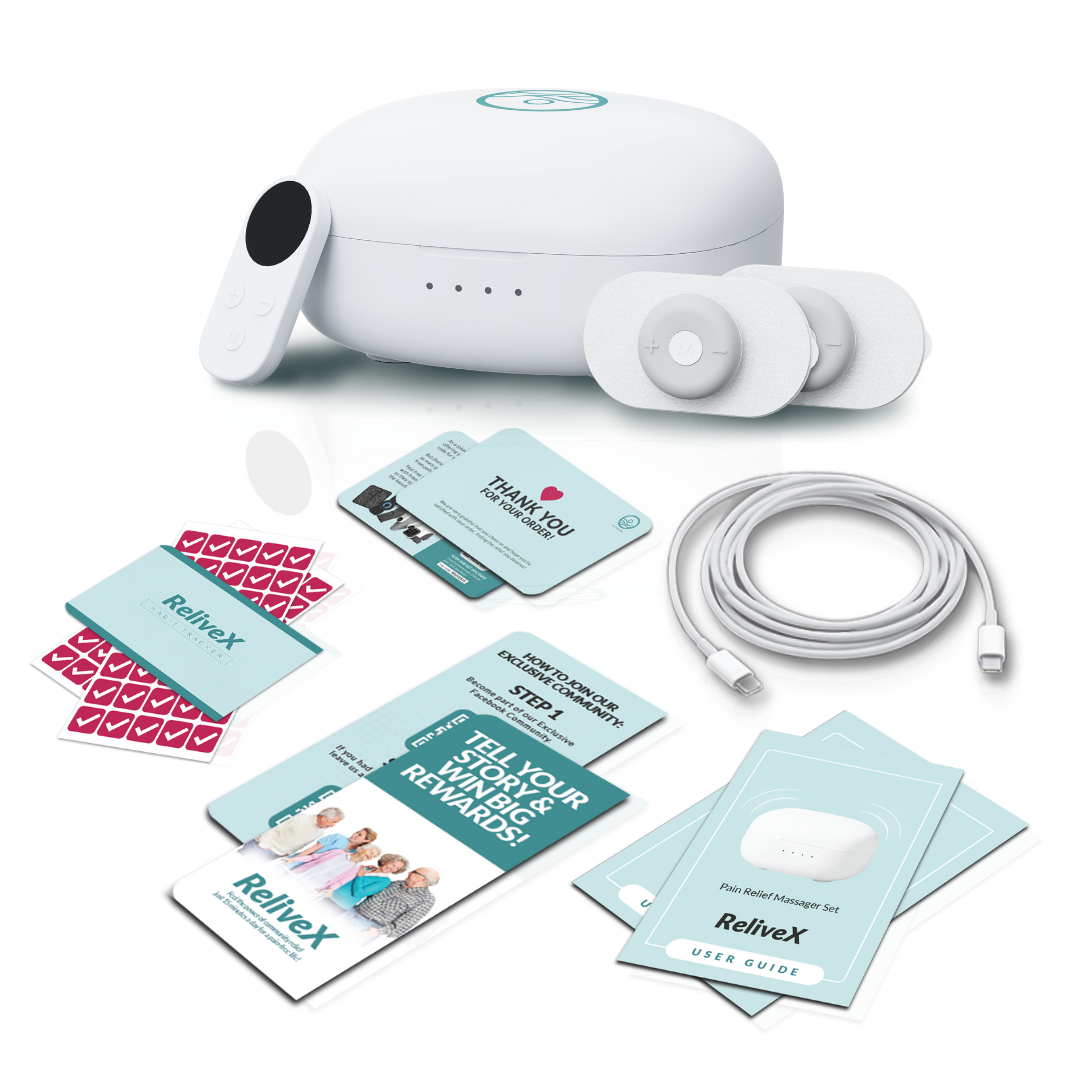
After years of development, a team of neuromuscular engineers and rehabilitation doctors created the ReliveX Adaptive NMES™ System — the first home device powerful enough to actually reach the multifidus and break the Core Muscle Lockout.
ReliveX is not a TENS device. It's a Dual-Action Correction System.
Every 15-minute session uses two distinct phases:
Phase 1 — Release & Decompress: A gentle, rhythmic wave immediately relaxes the surface muscles that have been overworking to compensate for the collapsed foundation. Users report an immediate feeling of pressure lifting from the lower back — like the spine is being supported from the inside for the first time.
Phase 2 — Reactivate & Rebuild: The adaptive pulse automatically adjusts depth and frequency, penetrating through surface tissue to reach the multifidus directly. It forces the muscle to contract — even though your brain shut it down. Over 15 minutes, this re-educates your nervous system. Your brain begins to remember how to use this muscle again.
Over 30 days of consistent use, the neuromuscular pathway rebuilds. The Core Muscle Lockout breaks. Your spine's internal brace comes back online.
What To Expect: The 30-Day Foundation Rebuild
First 15 minutes: Deep, rhythmic pulsing — not painful, but a clear sensation that something is working deep in your back. Most users describe an immediate feeling of "lightness" or pressure relief in the lower back.
Week 1: Morning stiffness reduces. You stop needing thirty minutes to warm up before you can move. Sleep improves because you're not waking up every time you try to roll over. Your surface muscles are starting to let go.
Weeks 2–4: Posture improves naturally — you'll notice you're standing straighter without thinking about it. Walking farther gets easier. Activities that used to cause fear — bending, standing through dinner, walking more than a block — start becoming possible again.
Week 4+: The foundation is rebuilt. The need for pain medication drops significantly. You use ReliveX 2–3 times per week for maintenance — and the pain stays gone.
Why ReliveX Is Different From Everything You've Tried

Why ReliveX Is Different From Everything You've Tried
✅ Targets the multifidus — not surface nerves. The only home device that reaches 30–50mm deep to address the actual foundation muscle.
✅ Dual-Action Adaptive Pulse — breaks the Core Muscle Lockout that no pill, injection, or surgery can fix.
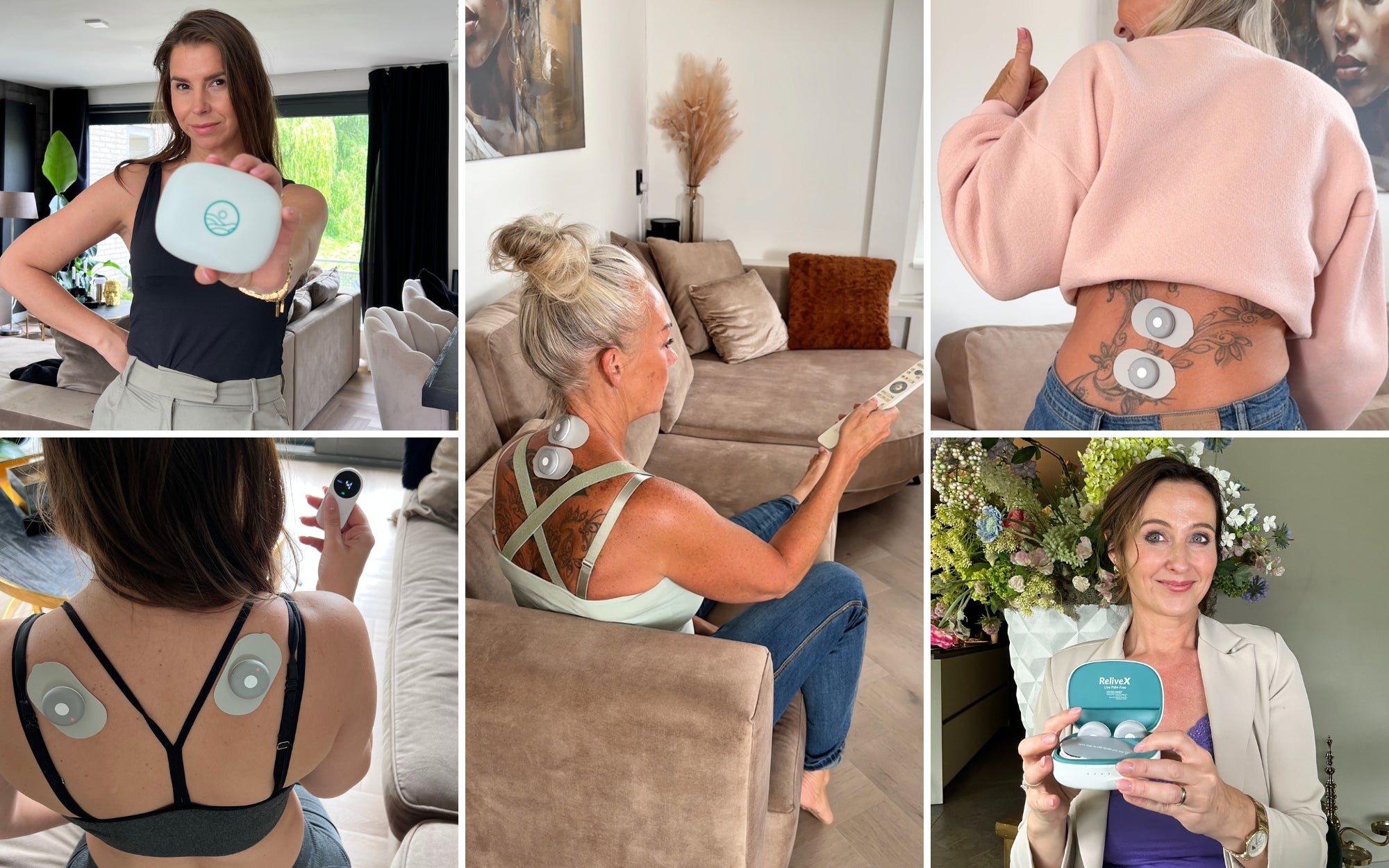
✅ Wireless & wearable — 15 minutes a day on the couch, at your desk, wherever you are. No wires, no clinic visits, no complicated setup.
✅ FDA-cleared & doctor-recommended — clinical-grade technology designed specifically for spinal stabilization, not a repurposed athletic device.
✅ 90-day money-back guarantee — long enough to complete the full reactivation protocol. You either feel the difference or you get every dollar back.
Stop Treating The Pain. Start Rebuilding The Foundation.
You've done everything your doctors told you to do.
You've taken the pills. Done the PT. Gotten the injections. Maybe even had the surgery.
And you're still in pain.
Not because your spine is unfixable. But because nothing you tried addressed the muscle that controls everything — the one that doesn't show up on any imaging, that nobody ever tested, that has been shut down since your pain began.
ReliveX is the first device that does.
TODAY: Get 50% OFF the ReliveX Adaptive Correction System
Plus 3 Free Gifts:
🎁 A Personalized Treatment Guide developed by our rehabilitation experts
🎁 The "Stenosis & Core Reset" E-Book with simple mobility and stretching routines
🎁 Access to the ReliveX Private Support Community for tips and accountability
The 90-Day Pain-Free Promise: If you are not experiencing significant, lasting improvement after 90 days, send it back for a full refund. You have nothing to lose but the pain.
Stock is limited due to high demand — click below to check availability and claim your discount:
IMPORTANT INFORMATION
ReliveX™ is offering a unique deal to our readers! You can order it now with 50% off, and shipping is FREE.
Stock may be limited (due to high demand). Click the button below to check availability and secure your 50% discount.
Where can I get ReliveX™?
You can find it directly on the official website by clicking here.
PS: ReliveX™ is also protected by a 90-day money-back guarantee. Simply send an email and you’ll get your money back.
Finally Get Instant Relief from Spinal Stenosis & Nerve Pain
Recommended:

4.8 | 5.876 Reviews

SPRING SALE: Get 62% Off + Free Shipping!
Comments

James Whitaker 11 hours ago
My doctor confirmed L4-L5 stenosis two years ago. I'd already had laminectomy and was still in agony — surgeon said everything looked perfect on the X-ray. I couldn't walk more than five minutes without my legs going numb. Started using ReliveX 6 weeks ago. I don't know how to explain it but something feels structurally different — like my lower back actually has support now. I'm walking my dog every morning again. First thing in over two years that didn't just mask the pain.


38 likes__Comment

Emily Carter 1 day ago
Three epidurals in eighteen months. First one worked beautifully. Last one lasted maybe two weeks. My doctor started talking about fusion and I panicked. A friend sent me this article and honestly I rolled my eyes — I'd tried every gadget out there. But the explanation about the multifidus finally made sense of why nothing ever held. Six weeks in and I've cancelled my surgical consultation. I'm not pain-free but I feel stable for the first time in years.
15 likes__Comment

Sarah Mitchell 1 dag geleden
I was waking up at 3AM every single night unable to roll over. Spent thirty minutes every morning just warming up enough to walk to the kitchen. I was embarrassed to tell people how small my world had gotten. The shopping cart thing in this article — that was me, every single grocery trip. Four weeks with ReliveX and I'm sleeping through the night. I get out of bed like a normal person. That alone is worth everything.
21 likes__Comment

Daniel Thompson 2 days ago
This product is amazing! For anyone who has ever used an older model TENS device: you end up completely tangled in the wires, and if you need to use it at work to reduce flare-ups, it’s impossible when you have a job that requires a lot of movement. This product frees you from all that and allows you to use it safely. Thanks to whoever created this product.

31 likes__Comment

Olivia Bennett 2 days ago
Had L4-L5 fusion four years ago. Surgery was 'successful' but the pain just moved — exactly like the article describes. Turned out L3-L4 was now breaking down. My surgeon mentioned a second surgery and I refused. This article was the first time anyone explained WHY the fusion didn't fix everything. The multifidus explanation made complete sense. Ten weeks with ReliveX — my pain management doctor actually asked what I'd changed because my baseline pain scores dropped so significantly.
47 likes__Comment
MARKETING DISCLOSURE: This website promotes certain products and services. The owner has a monetary connection to the products and services advertised on this site.
ADVERTISING DISCLOSURE: This website and the products & services referred to on this site are part of an advertising marketplace. This website is an advertisement and not a news publication. Persons appearing on this site may be compensated brand representatives or actors unless otherwise stated.
HEALTH DISCLAIMER: This website is not intended to provide medical advice or to replace medical advice and treatment from your physician. ReliveX™ does not intend to diagnose, treat, cure, or prevent any disease and does not constitute medical advice. Visitors are advised to consult their own doctor or other qualified healthcare professional regarding the treatment of medical conditions. This site offers health, wellness, and educational information designed for informational purposes only. Do not disregard, avoid, or delay obtaining medical or health-related advice from your healthcare professional because of something you may have read on this site. The use of any information provided on this site is solely at your own risk. The U.S. Food and Drug Administration has not evaluated the statements on this website. Results may vary from person to person.